
My name is Jeroen van Dinther, and for as long as I can remember, I’ve been interested in how things work. That often meant taking things apart to figure it out, and then putting them back together again. Of course, that didn’t always go well, but practice makes perfect.
During my last years of elementary school, I often helped out at a bicycle shop next to the school, where bicycles, mopeds, and motorcycles were sold and repaired. Ultimately, that probably contributed to my love of technology and my decision to study mechanical engineering.
During my college years, I was able to buy my first car, a Datsun 100A, and because of my limited budget, I quickly became a regular at the junkyards in my immediate area. I still enjoy searching for parts at a junkyard, partly because you’re giving those parts a second life. I also prefer to repair something rather than replace it immediately with a new one.
For years, I subscribed to monthly magazines about classic cars, and I still vividly remember the 1990 motor show in Essen. I was there with a friend, and we saw the Mazda MX-5 in person for the first time. We both agreed that it was definitely “the treat of the week.” So the car had clearly made a good first impression.
For years, I drove lease cars. As a result, tinkering with cars was a rare occurrence; it was more a matter of keeping the car we were using privately as a family at the time running.
In 2013, around the time of my 50th birthday, I decided it was time to treat myself to a hobby car. I hadn’t forgotten about the MX-5, and since I wanted to buy a fun, reliable convertible for relatively little money, I started looking for one.
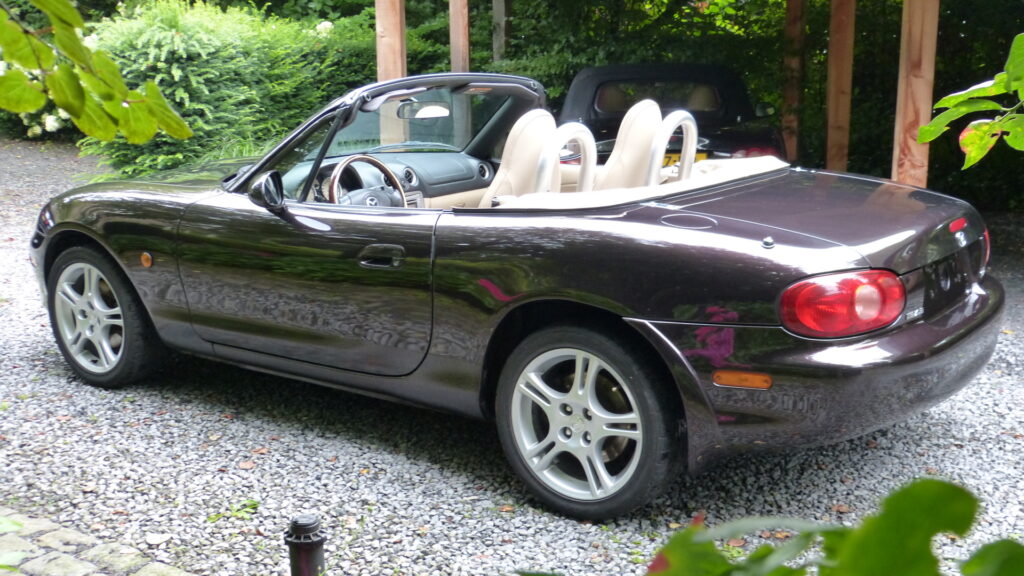
After test-driving a 1990 American Miata, a Canadian NB, and an NBFL, I decided to have the latter inspected before purchase. It was an original Dutch car—the most expensive trim level listed for its model year. The 2005 1.8 S-VT Sportive in Brilliant Black with a black interior had about 76,000 kilometers on the odometer at the time. The car rolled off the assembly line fully equipped, including air conditioning—an option that wasn’t often selected. The pre-purchase inspection revealed that the air conditioning was leaking, but since that resulted in a substantial discount on the purchase price, I bought the car.
In the early years, I mostly just drove the car and did little to no tinkering with it; that changed when I felt the need to customize the car more to my own taste. The desire to install cruise control led to a project—a process involving extensive research, importing original parts from North America, searching for connectors at auto salvage yards, and running the missing wiring—all to ultimately create a working system. After that, I made many other, mostly cosmetic, modifications.
The results of the cruise control project, along with the other updates, were shared with an MX-5 group on Facebook. As a result, I started receiving more and more technical questions. I’ve always enjoyed answering them and, through online research and experimentation, have gained a lot of knowledge in the process. Through this website, I want to share that knowledge. I find it hard to predict the direction this website will take, but I’m certain I’ll enjoy the process.
In August 2021, I bought a second MX-5: a Memories III with a 1.6-liter engine, originally from Oberhausen, Germany. It’s a project car, purchased after it failed its TÜV inspection because the roll bars were rusted through. Project Oberhausen is an experiment—on the one hand, to give the car a second life, and on the other, to see how much fun we’d have touring the area with two MX-5s, either with our own family (my wife and two daughters) or with friends.
You can get in contact with me using the options listed on the Contact page